


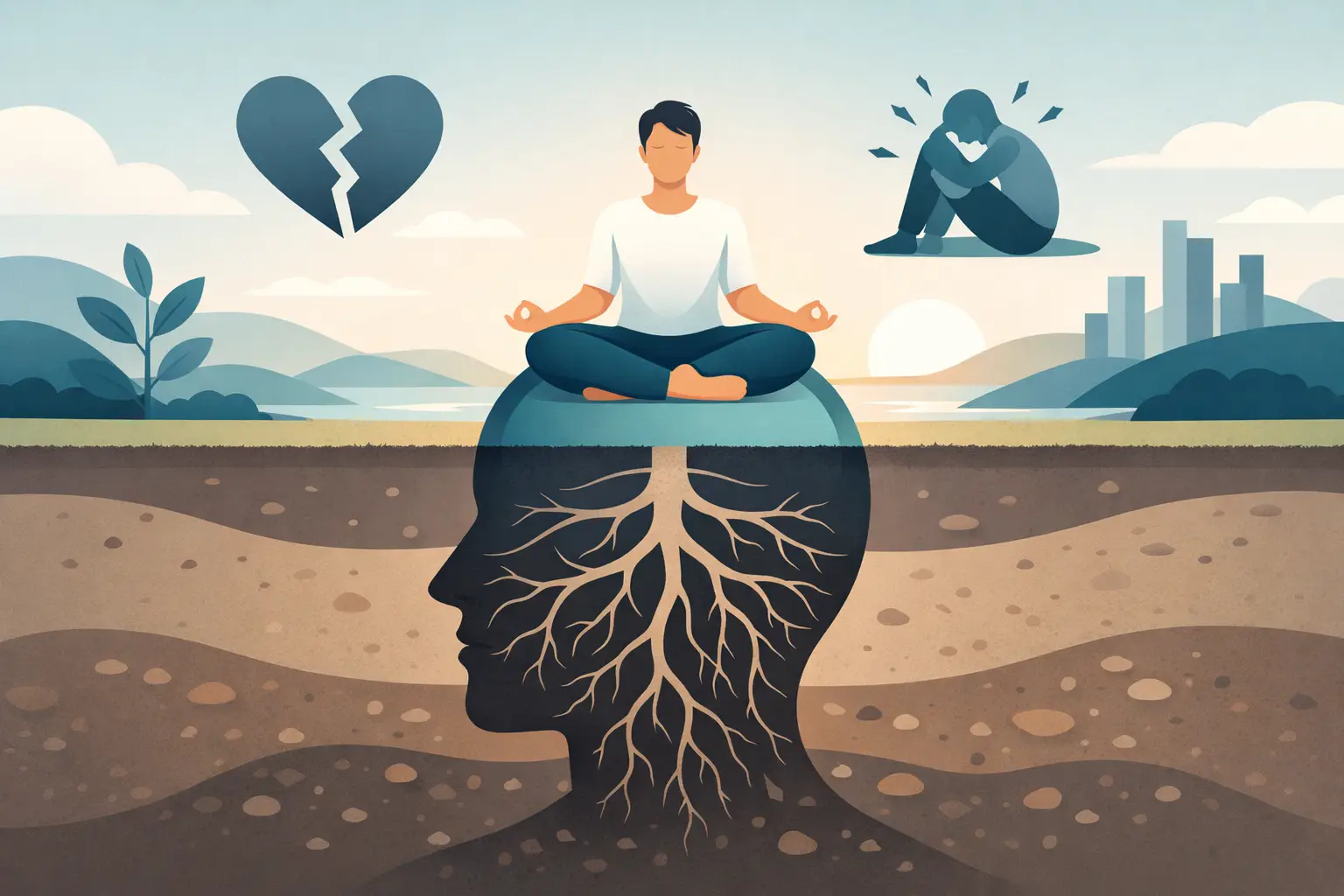
Healing from attachment and trauma begins at the root.
There are people who appear strong on the outside, but crumble inside whenever someone they love is away, a tone of voice changes in a relationship, or a message goes unanswered for hours. What's happening here isn't a weakness of character, and it's often not an exaggeration. In many cases, healing from attachment and trauma begins when we understand that what we call attachment may actually be a survival response formed at a time when the body didn't feel safe.
When a person experiences repeated painful experiences—neglect, rejection, emotional instability, cruelty, or loss—their nervous system learns that closeness is not just a desire, but a survival necessity. Then the person grows up, and circumstances change, but the pattern remains. They seek solace in others, not because their heart is weak, but because their inner self is still trying to resolve old pain with old methods.
Why is attachment intertwined with trauma?
Attachment itself isn't a problem. We are created for connection and bonding. The problem arises when the relationship becomes the only place where we feel we exist, or when the fear of loss becomes the focus of our inner lives. At that point, it's no longer healthy love, but rather a threatening attachment.
Trauma doesn't always mean a single, large, obvious event. Sometimes it's the silent accumulation of years of emotional insecurity. A child who never found someone to contain their fears. A teenager who learned to monitor others' moods to avoid pain. An adult who's professionally successful but crumbles if they feel unwanted. These aren't contradictions. These are highly effective protection systems, but working in the wrong direction.
When a relationship is wounded, hope often emerges as well. Therefore, a person might cling to someone unsuitable, repeat the same pattern despite knowing it, or engage in a painful push and pull that they know is draining them. The mind may see the truth, but the body seeks comfort, even if it's harmful.
What does unhealthy attachment look like after trauma?
Not all attachment is obvious. Some manifests as excessive clinging, while others as aversion and withdrawal. Some pursue closeness relentlessly, while others flee at the first sign of need. Both may be affected by past trauma.
You might find yourself interpreting distance as rejection, or constantly seeking reassurance that never lasts. You might feel intense anxiety if the other person's behavior changes even slightly. You might get caught in a cycle of overthinking, monitoring, appeasing, or even anger and blame. Conversely, you might convince yourself that you don't need anyone, while deep down you harbor a profound fear of attachment itself.
These patterns are not moral flaws. They are signals. Every overreaction to the current situation is silently asking: What happened in the past that made the present seem so dangerous?
Healing from attachment and trauma does not mean cutting off feelings.
One of the most confusing ideas is that healing means coldness, complete detachment, or becoming unaffected. This is inaccurate. Healing doesn't extinguish the heart; it frees it from panic. It doesn't turn you into someone who doesn't need, but someone who can need without breaking down.
When you begin your healing journey, you don't learn to ignore your pain, but rather to understand and cope with it. Relationships are no longer your only source of comfort. You develop an inner world too vast to be swallowed by fear every time. And you become able to distinguish between love and attachment, between natural human need and dependence fraught with panic.
This difference is crucial. Because many people try to address attachment solely through discipline—cutting off contact, distracting, ignoring, filling time—and are then surprised to find the same pattern reappearing with someone else. The reason is that the root cause hasn't been addressed yet.
Where does recovery actually begin?
The real issue isn't the relationship itself, but your nervous system. If your body is in a state of chronic alert, mental understanding alone won't suffice. You might know the person isn't right for you, yet feel unable to let go. You might realize your fear is exaggerated, but your body simply won't believe it.
Therefore, healing requires two parallel paths: a genuine awareness of the root causes, and structured action that helps the body experience safety rather than merely contemplate it. This is where the value lies. trauma-conscious approachesBecause it doesn't just analyze the story, but pays attention to what's happening inside you moment by moment.
In some cases, you first need to calm the body's heightened arousal before delving into the details of the past. In other cases, it helps to understand the conflicting internal parts: the part that clings, the part that fears exposure, and the part that blames you after every impulse. Sometimes, what's required isn't to resist these parts, but to understand their function, respect their protective intent, and then guide them from a calmer place.
What helps in healing from attachment and trauma?
The first thing that helps is to stop self-flagellation. Shame feeds the pattern, it doesn't heal it. When you see yourself as "overly attached," "complicated," or "difficult," you're adding a new wound on top of the original one. The language you use with yourself is part of the healing process, or part of the perpetuation of the problem.
Second, learn to recognize the warning signs before you break down. Before you send the tenth message, or go into a cycle of overanalysis, or withdraw completely, there's a tiny moment when the body precedes the action. A tightness in the chest. A constriction in the stomach. A feeling of heat. A racing of thoughts. This moment is precious. If you learn to see it, you're beginning to regain control.
Third, seek support that understands the trauma, not just the behavior. Not every space will help you heal deeply. Some advice may seem powerful, but it can be harsh on an already strained nervous system. For example, simply telling you to “get over it,” “be stronger,” or “detach your emotions” can lead to repression, not liberation.
The most mature approach is the one that balances kindness and structure; between being contained and being guided; between having your pain understood and also being invited to take responsibility for your healing. This is what makes deep work different from quick motivational content.
Why is awareness alone not enough?
Many people say, “I understand myself well, yet I still repeat the same things.” This is very common. Because understanding doesn't equal integration. You may know that your attachment is linked to childhood, but that doesn't mean your body has stopped sounding the alarm.
Awareness is a crucial step, but it's not the final one. Healing requires new experiences repeated enough for the nervous system to readjust. It needs a safe relationship, a mindful therapeutic space, physical and organizational practices, or all of these combined. And before all that, it needs honesty: Am I ready to face my pain instead of running from it in another relationship?
This is where the importance of approaches that work with both body and mind becomes apparent, such as compassionate inquiry, andIFSTRE, and NARM. The point isn't the names themselves, but the approach: to view symptoms as intelligent signals, not flaws to be crushed. To work on the root cause instead of merely managing the surface.
Signs of true healing
Healing doesn't mean you'll never be hurt again. But it does mean that the pain won't devour your identity every time. You begin to realize that distance is no longer the end of the world. That you can feel needed without losing your dignity. And that you're better able to distinguish between attraction that reopens old wounds and attraction that brings safety and consistency.
Another sign of healing is that boundaries become less daunting, that your urge to prove yourself or win love at any cost diminishes, and that the inner tension that tied your worth to others' opinions lessens. Not all old responses may disappear quickly, but your relationship with them changes. They no longer control you as they once did.
This path is not linear. Sometimes you feel you've come a long way, then you're jolted back by a small setback. This doesn't mean you're back to square one. It often means a deeper layer has surfaced. Mature healing doesn't measure itself by perfection, but by the breadth of your ability to remain present with what unfolds.
When you need real companionship
Some wounds cannot be healed by reading alone, no matter how sincere the reading. There are moments when a person needs someone to walk with them consciously, not someone to give them slogans. They need a safe space where they can clearly see their patterns and gradually unravel the connection between closeness and fear, between love and threat.
This kind of work isn't a luxury for those experiencing chronic anxiety, strained relationships, or inner emptiness despite their accomplishments. Rather, it can be the turning point that restores inner order. When this work is done consciously and deeply, a person begins to reclaim something they thought was lost: themselves.
In a work like that presented by Montasir Musa, the value is not in providing ready-made answers, but in accompanying the person towards a more truthful vision of their roots, and rebuilding security from within rather than through controlling the outside.
If you're tired of repeating the same pattern, don't treat it as a personal failure. Perhaps this isn't the end for you, but rather your first indication that what your heart needs isn't more endurance, but a deeper, calmer, and more honest path to healing with what you've truly experienced.