


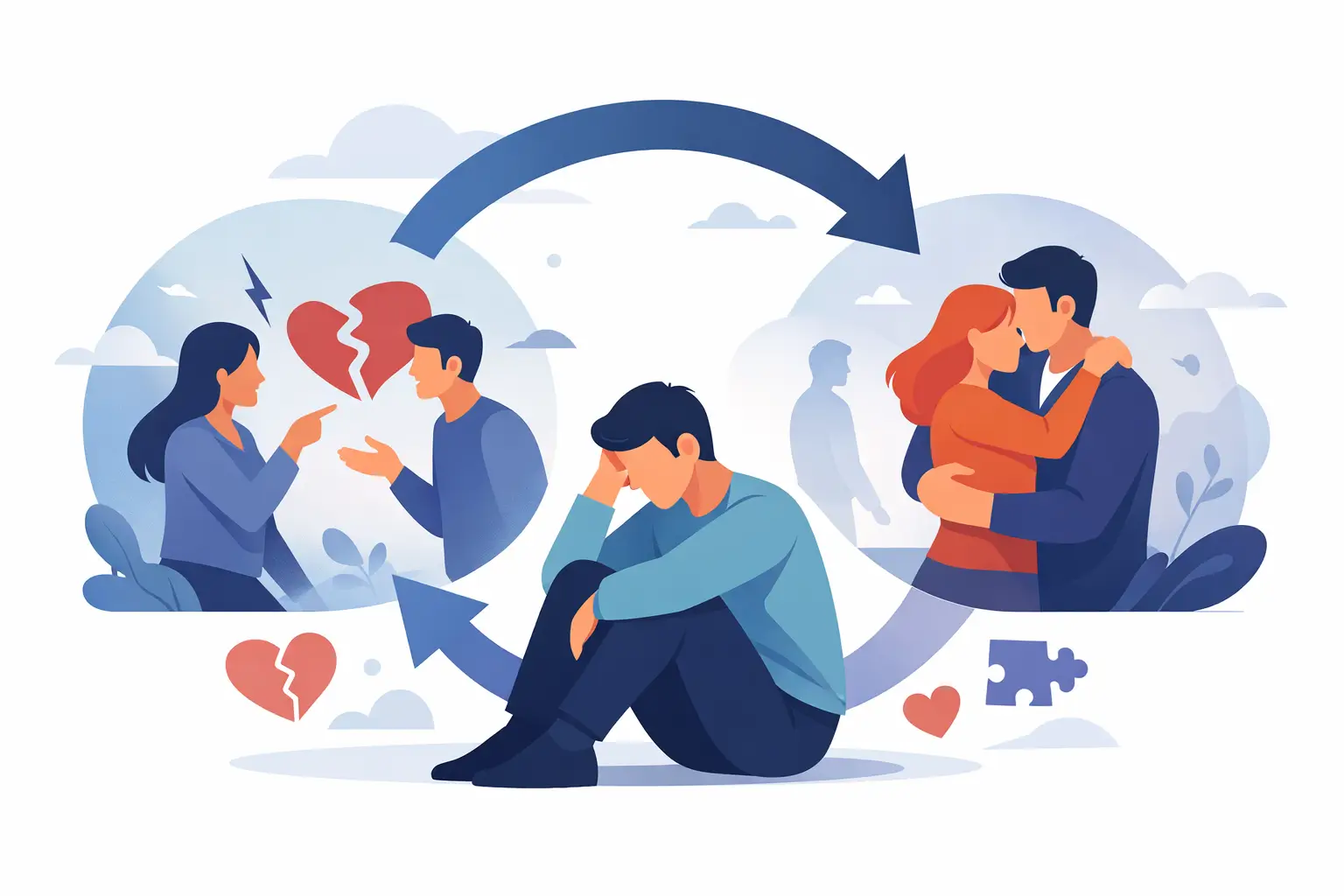
Why do I repeat the same emotional pattern in my relationships?
Sometimes the problem isn't the person who's just entered your life, but something that awakens within you each time. You're drawn to those who confuse you, or you stay with those who don't see you, or you run away the moment true closeness begins. Then you ask yourself, with painful honesty: Why do I keep repeating the same emotional pattern even though I've become more aware, more cautious, and perhaps even more tired?
This question isn't a sign of failure. It's often the beginning of true maturity. Because repeating an emotional pattern doesn't mean you don't understand; it could mean your nervous system learned early on to survive in a certain way, and then continued to repeat the same response even after your circumstances changed. The mind says one thing, but the body, emotions, and emotional memory say another.
Why do I repeat the same emotional pattern even though I know what hurts me?
Awareness alone doesn't always break the pattern. You might know perfectly well that this person is emotionally unavailable, that this relationship is draining you, or that your fear of abandonment is driving you to compromise yourself. Yet you still go back. Not because you're weak, but because there's still a part of you that connects love with pain, closeness with tension, security with the struggle to prove your worth.
Many recurring emotional patterns are formed in early environments where love wasn't constant, clear, or secure enough. Perhaps you had to be too quiet to avoid rejection, too strong to prevent the family from falling apart, or always understanding to avoid losing touch. Here, an unspoken, internal contract is formed: to remain loved, I must give up something of myself.
Later, this pattern doesn't emerge as a straightforward idea. It manifests as a recurring choice. You're drawn to those who make you work hard to gain your favor. You feel bored with someone who's stable because your system doesn't interpret tranquility as security, but rather as something strange and unfamiliar. This is a painful truth, but it's more common than it seems.
Emotional pattern is not just a habit, but a survival response.
Upon closer examination, we find that recurring emotional patterns aren't simply a matter of poor judgment. Sometimes, it's an ingrained internal mechanism. The nervous system gravitates toward the familiar, not necessarily the healthy. And the familiar might be tension, ambiguity, excessive attachment, or cold withdrawal.
If you grew up in an environment where love was linked to caution, you may feel a strong attraction to someone who awakens that same caution in you. If you learned that your needs are a burden, you may enter relationships where you give a lot and receive little in return. And if you experienced early heartbreak, you may preemptively withdraw before anyone even gets close to you.
From the outside, these options may seem illogical. But internally, they are remarkably consistent with a long-standing neurological and psychological history. That's why it's not enough to simply tell yourself, "This is the last time." If understanding doesn't go hand in hand with healing, the pattern will often return in a new guise.
How does the pattern appear in different forms?
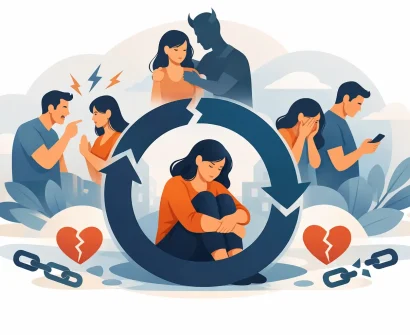
Sometimes you think you've moved on because this time your partner is different in the details. But the essence is the same. The first person was cold, the second was busy, and the third is hesitant. The outward appearances have changed, but the effect inside you hasn't: uncertainty, emotional hunger, constant monitoring, and a feeling that you have to earn love instead of receiving it.
This is where many people fall into a painful trap. They focus on the quality of the partner and fail to see the internal mechanisms that choose, interpret, become attached, and fear. This is why the pattern repeats itself even when the names and stories change.
Common roots of repeating the same emotional pattern
One of the most common roots is insecure attachment. Not just in its theoretical sense, but as a daily, internalized experience. Anxiety about messages, tension about silence, overanalyzing tone, or complete withdrawal when you feel you might be rejected. This isn't exaggeration or being fussy. It's often an expression of a mechanism that has learned that relationships are unstable.
The second root cause is subtle trauma. You don't necessarily have to have experienced traumatic events in the conventional sense. Sometimes, a long history of exclusion, criticism, shame, emotional neglect, or feeling invisible is enough. These experiences leave their mark not only on memory but also on self-perception. You become accustomed to diminishing yourself, doubting your own feelings, or clinging to those who reinforce the same unresolved feelings.
The third root is the conflicting inner parts. One part desires love, while another fears it. One part yearns for closeness, while another is suspicious of anyone who approaches. One mature part knows what suits it, while another, still clinging to the past, seeks to mend old wounds through a new relationship. When we fail to understand these parts, we experience them as a confusing contradiction. When we understand them, compassion replaces self-flagellation.
Why am I attracted to someone who is not suitable for me?
Because attraction isn't always a sign of compatibility. Sometimes it's a sign of activation. The person who awakens an old story in you might seem familiar, profound, or even fateful. But this feeling doesn't necessarily mean the relationship is healthy. It might simply mean that some old stuff has been stirred up.
Conversely, a calm person might not initially excite you in the same way, because your mind isn't used to tranquility. This doesn't mean that every calm relationship is suitable, nor that every strong attraction is harmful. It's more nuanced than that. But it's important to distinguish between security and spark, and between genuine presence and emotional addiction.
How do I start breaking the pattern instead of repeating it?
The first step isn't to immediately seek a new, better relationship, but rather to learn to recognize the pattern in action. When do you start compromising? When does anxiety become the driving force? When do you confuse love with fear? And when do you ignore the obvious signs because a part of you doesn't want to face the painful truth?
This kind of observation doesn't require harshness. It requires honesty and trust. Because if you observe yourself with a judgmental eye, you'll only reopen the wound. But if you observe yourself with understanding, something inside you will begin to loosen. And that's when change becomes possible.
The second step is to return to the root cause, not just the behavior. Yes, setting boundaries is important. And yes, slowing down the relationship is important. But sometimes you set excellent boundaries on the outside while inside you're still crumbling with fear. Sustainable change happens when the body learns that security is possible, that closeness doesn't mean loss, and that saying no doesn't mean losing love.
This is why in-depth work is beneficial. Some people benefit from approaches that consider trauma, understand internal dynamics, and work with neurological organization, not just ideas. Because in many cases, the problem isn't a lack of information, but rather unresolved pain. This is where the value of approaches that view the individual as a whole, not as a collection of ideas to be quickly corrected, becomes apparent.
What should I do if I am aware but the pattern continues?
I know this happens often. You might read, understand, and name everything precisely, then find yourself in the same place. This doesn't mean your consciousness is false. It means some patterns are too deep to be changed by insight alone. You need a different experience, a safe relationship, and a space where your nervous system is allowed to slowly learn something new.
Sometimes, what's needed is to stop asking, "How can I stop myself from repeating myself?" and start asking, "What is this pattern trying to protect within me?" When you ask in this way, the internal struggle transforms into a dialogue with yourself. Instead of seeing yourself as someone who's ruining their life, you begin to see the part of yourself that's still trying to survive with outdated tools.
This is no small step. It's the beginning of regaining inner control. And when you regain that control, you won't need to suppress your feelings or freeze yourself to make the right choices. You'll become more capable of clear perception, of noticing signs early, and of staying true to yourself, even if it hurts.
Why does the pattern change when I feel safe with myself?
Because your relationship with yourself is the foundation of every other relationship. When your inner self is less fragmented, you'll feel less need to seek someone to validate you or fill a long-standing void. And when your tolerance for solitude grows, you'll be less likely to settle for scraps just to avoid being alone. When you make peace with your needs, you won't feel burdened or overwhelmed simply because you crave constant closeness and respect.
Healing here doesn't mean you'll never be drawn to the wrong thing again, or that you won't get hurt. It means that repetition won't be your destiny. You'll pick up on the signal faster, trust your instincts more, and walk away from the relationship that reopens old wounds before it consumes you completely.
If you're asking today why I keep repeating the same emotional pattern, perhaps the deeper question isn't: What's wrong with me? But rather: What story is still waiting to be understood, contained, and healed? When you approach yourself from this point, real change begins. Not with force, but with security. Not by pretending you've moved on, but by finally stopping running from the root cause.