


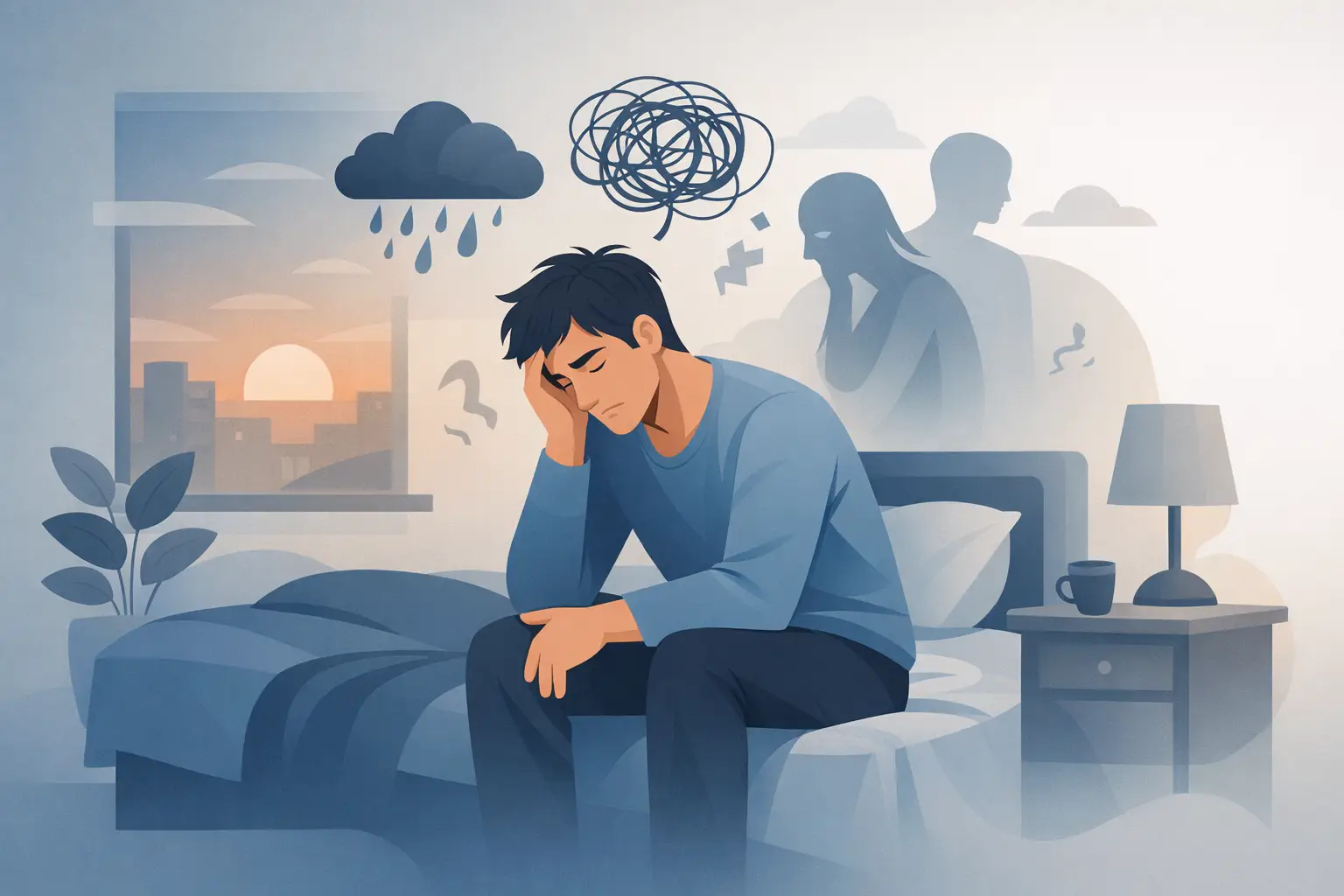
Why do I always feel mentally exhausted?
Some people end their day exhausted because they've worked too hard. Others end their day feeling mentally drained even if they haven't done anything significant. If you find yourself asking, "Why do I always feel mentally exhausted?" the answer isn't a sign of weakness, self-pity, or a lack of gratitude. Often, this exhaustion is a message from your nervous system, from your suppressed emotions, and from those parts of you that have endured more than they should for too long.
Mental exhaustion isn't just a bad mood. It's a state of internal depletion that leaves you waking up feeling like you haven't rested, performing even the simplest tasks with double the effort, and smiling at people while carrying an inexplicable weight inside. Sometimes the cause seems obvious—work stress, family problems, lack of sleep. And sometimes there seems to be no logical reason, which is precisely what confuses you and makes you doubt yourself.
Why do I always feel mentally exhausted even though my life seems normal?
Because what's truly troubling you isn't always what others see. Your life might appear relatively orderly on the outside, but inside, you're in a constant state of alert. Many high-performing, career-oriented people are adept at maintaining their momentum, but they lack inner peace. They accomplish tasks, meet expectations, smile, and then return home empty.
The nervous system isn't as concerned with the external aspects of life as it is with the internal sense of security. If you've experienced prolonged periods of anxiety, family tension, high expectations, criticism, or disappointment, your body may have learned to remain on high alert even after the event itself has passed. This is when psychological fatigue becomes chronic, because you're not only expending energy on living life, but also on protecting yourself from it.
This explains something important: why traditional rest is sometimes insufficient. You might sleep more, take a vacation, and lighten your schedule, but you still don't feel truly refreshed. The reason is that the problem isn't just a lack of rest, but an underlying internal burden that hasn't been addressed at its root.
The deeper causes of persistent psychological fatigue
1) Chronic stress that has become normal for you
When you live under prolonged stress, your mind begins to treat it as the baseline. You stop noticing that you're constantly tense, shallow-breathing, or always expecting the worst. This kind of stress doesn't always shout; it whispers throughout the day. Over time, it consumes a tremendous amount of your mental and emotional energy.
The problem here is that a person might say, "I'm used to it." But being used to it doesn't mean the cost has disappeared. It just means you no longer call it by its name.
2) Repressed feelings
Unexperienced emotions do not disappear. They remain inside and take up space in our attention and energy. Unexperienced sadness, repressed anger, minimized fear, and disappointment that has not found a suitable language – all turn into an inner burden.
Some people are taught from a young age to be overly rational or to be strong all the time. This may give them the ability to persevere, but it comes at a silent psychological cost. The exhaustion here isn't because you're overly sensitive, but because you're carrying more than you admit.
3) Living in constant internal conflict
Sometimes the weariness isn't from life itself, but from an inner conflict. Part of you wants rest, while another part refuses to stop. Part wants to say no, while another fears disappointing others. Part craves closeness, while another trusts no one.
This kind of conflict is very draining because you're not channeling your energy in one direction. You're expending it in a tug-of-war within yourself. From the outside, you might seem indecisive or moody, but inside, you're putting in a tremendous effort just to keep yourself together.
4) Survival pattern instead of lifestyle
When a person lives for years in a survival mode, the focus becomes solely on avoiding collapse, not on experiencing life. You get things done, postpone your needs, adapt, and tell yourself: I'll rest later. But that later rest period can be very long.
Survival mode makes a person physically present but emotionally absent. This may explain your feelings of apathy, loss of passion, or inability to enjoy even things you used to love.
How do you differentiate between temporary fatigue and deeper psychological fatigue?
Transient fatigue is often linked to a clear cause and improves with sleep, reduced stress, or the passing of the situation. Deeper psychological fatigue, however, persists even after circumstances have somewhat improved. You feel burdened internally without sufficient explanation, and you feel like you're constantly running on low energy.
You might also notice that your reactions have changed. You get easily agitated, withdraw quickly, cry over small things, or feel a numbness that's unlike you. Not because you've become weaker, but because your inner voice is clearly telling you: I'm overwhelmed.
If this is accompanied by insomnia, physical tension, chest tightness, difficulty concentrating, or a constant feeling of threat even on quiet days, then the issue is often deeper than the exhaustion of two days or a difficult week.
Why don't quick tips always work?
Because some advice addresses the symptom, not the root cause. Organizing your time is helpful. Getting enough sleep is important. Exercising is excellent. But if your fatigue is linked to a history of anxiety, chronic alertness, or repeated minor traumas, simply adding a new habit to an already strained nervous system won't be enough.
We're not talking against healthy habits here, but against reducing the problem to a simplistic view. Sometimes, a person needs something deeper than motivation and discipline. They need to understand why they ended up in this situation in the first place. They need a safe space where they aren't asked to be stronger, but simply to be honest.
What does this type of fatigue require?
The first thing he needs is to stop blaming himself. Many people increase their psychological distress because they attack themselves for it. They say: I have so many blessings, why am I like this? Or: Others endure more. But comparison doesn't heal, and self-flagellation doesn't restore energy.
Secondly, it requires a structured, not chaotic, understanding. Not all psychological distress has a single cause. Sometimes it stems from a draining relationship. Sometimes it's the result of accumulated stress that went unaddressed. And sometimes it's because you're living too far from your true self, playing a role that doesn't reflect who you are. The healing process begins when you stop generalizing and start to clearly see your own patterns.
Third, it requires genuine work with the body, emotions, and inner patterns, not just with ideas. Many people understand themselves intellectually very well, yet they remain exhausted. Understanding is important, but it's not always enough. Some old burdens can't be lifted by mental discourse alone, because they're stored in physical tension, automatic responses, and inner parts that still live as if the danger hasn't passed.
Why do I always feel mentally exhausted when I am alone?
Because solitude sometimes reveals what you've been putting off all day. While busy, you have distractions. But when you're quiet, anxiety, sadness, emptiness, or unanswered questions surface. That's why some people aren't afraid of rest itself, but rather what it will reveal to them.
This doesn't mean the solution is to escape solitude. Rather, it means that what emerges within it deserves to be heard with kindness and honesty. Sometimes our most distressing moments hold the clearest clues to what we need inside.
When does asking for support become a mature step, not an exaggeration?
When exhaustion lingers longer than necessary and begins to affect your sleep, relationships, concentration, or self-esteem, and when you notice that all your attempts to cope are draining you more than helping you, seeking support is not an admission of helplessness, but a conscious decision that you no longer want to push your life through the drain.
Good support doesn't just give you general advice; it helps you see the root cause, understand your responses, and gradually build inner security. This is crucial because someone who is emotionally exhausted needs not just an explanation, but a different experience where they feel they are no longer alone in carrying this burden.
In trauma-conscious therapy or counseling, the goal is not just to reduce symptoms, but to restore your relationship with yourself. It's about understanding why you were living under so much stress, why your body felt so tired even when you appeared healthy. This kind of understanding not only eases the mind, but also opens a real door to change.
If you've been asking yourself for a while, "Why do I always feel so mentally exhausted?" perhaps it's time to rephrase the question. Instead of asking, "What's wrong with me?" ask, "What have I been carrying alone for so long?" This question is more compassionate, more honest, and often the first step.
You don't need to prove you're broken to deserve support. It's enough to acknowledge that you're tired inside, that this tiredness has meaning, and that healing begins when you stop ignoring the message.