




Trauma-conscious recovery practices: What are the benefits?
There are people who appear remarkably composed on the outside. They accomplish tasks, smile, endure, and carry on with their day without anyone noticing the magnitude of their inner struggle. But inside, there is constant tension in the body, restless anxiety, fragmented sleep, and a strange disconnection from oneself. This is where the value of conscious trauma recovery practices emerges—not as a quick fix, but as a different way of understanding what is actually happening. What you call lethargy might be paralysis. And what you perceive as weakness might be a nervous system that has long been in survival mode.
Conscious trauma recovery doesn't begin with the question, "How can I do better?" but with a more honest question: "Why do I feel like I'm fighting myself all the time?" This shift is important because it moves you from self-blame to self-understanding, and from trying to control your symptoms to listening to what those symptoms are trying to tell you.
What are the practices of conscious trauma recovery?
It's not simply about dwelling on the past or reliving painful memories. It's about working in a way that respects the impact of trauma on your body, emotions, relationships, and self-image. Trauma here doesn't just mean one large, obvious event. Sometimes, trauma is a long accumulation of neglect, fear, criticism, insecurity, or being forced to be strong before your time.
Therefore, trauma-conscious recovery practices focus on building inner security first. This is because they recognize that a person cannot heal while constantly on the defensive. And when security is lacking, even good advice can become harmful if applied under pressure or haste.
Why do superficial solutions fail with some people?
If you've tried meditation, time management, affirmations, or self-help courses, and still find yourself returning to the same anxiety, the problem isn't necessarily with you. Sometimes these tools are helpful, but they work on a behavioral level, while the wound is deeper—in the nervous system, in the connection, in the internal image of self.
A person who has lived under threat for a long time doesn't always respond to logic. They may know what they should do, but their body doesn't trust them. They may understand why they are agitated, yet find themselves repeating the same pattern. This doesn't mean they are uncommitted; it simply means that intellectual understanding alone isn't always enough.
Here, recovery becomes more genuine when it combines awareness, physical regulation, emotional work, and an understanding of the conflicting inner parts. This is what distinguishes trauma-conscious approaches from traditional motivational discourse.
Trauma-conscious recovery practices that actually make a difference
Not every practice is suitable for every person at every stage. What works at the beginning may not be enough later, and what benefits someone with high anxiety may not suit someone who is numb or detached. However, there are fundamental practices whose effects are clearly recurring when used consciously and gradually.
1) Build security before digging into pain
This is a point many people overlook. The desire to heal might push you to tackle everything at once. But the nervous system doesn't interpret courage the same way the brain does. If you tackle heavy files without sufficient resources, you could experience emotional exhaustion, burnout, or a painful setback.
Building security means things that seem simple but have a profound impact: learning to recognize early signs of stress, knowing what calms your body, minimizing draining environments, and setting clearer boundaries with what unsettles you. It also means treating yourself as an object that needs protection, not a project that needs quick fixes.
2) Listen to the body instead of ignoring it
Trauma doesn't just reside in the mind. Much of it remains in the body as tension, tightness, labored breathing, palpitations, or chronic fatigue. Therefore, structured physical practices are very important, especially for those accustomed to living solely with their heads.
The goal here isn't to force the body into a powerful discharge, but rather to gradually teach it to transition from threat to safety. Sometimes it starts with noticing your feet on the floor, lengthening your exhale, or tracking a tense area without trying to change it immediately. This sounds simple, but it rebuilds the relationship between you and your body. And for many people, this is the first time they truly feel present.
3) Understanding the inner workings instead of fighting the self
One of the most exhausting things for a person is feeling divided within themselves. Part of them wants closeness, and part is afraid. Part seeks comfort, and part refuses to let things rest. Part wants to express themselves, and part observes and prevents. This isn't so much a contradiction in personality as it is an internal system formed for protection.
When we treat these parts of ourselves with hostility, the conflict intensifies. But when we understand the function of each part, something important changes. The part that criticizes you might be trying to protect you from failure or rejection. And the part that withdraws might have learned that disappearing is safer than confronting you. This understanding doesn't justify harm, but it creates space for healing instead of perpetuating the internal war.
4) Re-evaluating the meaning of symptoms
Many of the symptoms we now dislike were once quite intelligent. Overthinking, pleasing others, hypervigilance, reticence, or even apathy—these can all be survival responses. The problem is that they persist after the danger has passed, and begin to disrupt life instead of protecting it.
Reinterpreting your symptoms is one of the most powerful practices in conscious trauma recovery because it breaks the cycle of shame. Instead of asking, "What's wrong with me?", you start asking, "What was this pattern trying to do to me?" This question doesn't absolve you of responsibility or excuse your actions, but it restores dignity to your experience.
5) Safe relationship as part of treatment
Not all healing happens in isolation. Yes, self-awareness is important, but many wounds are inflicted within relationships, and that's why part of the healing process requires a different kind of relationship—one characterized by presence, consistency, and patience. This is why working with someone trained in trauma has a different impact than simply talking to someone with good intentions.
A secure relationship doesn't mean dependency or perfection. It means having someone who helps you recognize your patterns without judgment or pressure, and who knows how to slow things down when they become too much. In this context, self-confidence begins anew, not as a slogan, but as a recurring emotional and psychological experience.
What could hinder recovery?
One of the biggest obstacles is rushing. The desire for comfort is understandable, but deep healing often doesn't like being rushed. There's also another, more subtle obstacle: turning recovery itself into a performance project. Wanting to be organized, mindful, at peace, and in control all the time. This might seem mature, but sometimes it's just a new version of the old pressure.
Another obstacle is working with someone who doesn't understand trauma well. Some approaches interpret everything as a lack of discipline, resistance, or negative thinking. This interpretation can increase your sense of failure. A trauma-aware approach, however, first asks: Does this person need encouragement, organization, security, or genuine emotional space?
How do you start in a way that doesn't hurt you?
Start from a place of honesty, not a place of perfection. Don't ask: What's the fastest way to change? Ask: What's draining my nervous system the most right now? Is it a relationship? Is it constant stress? Is it an old fear that surfaces in every decision? Then start with a small step that your body can tolerate.
This step might involve minimizing exposure to your triggers. It might involve tracking your distressing moments throughout the day. It might involve seeking support from a professional who understands trauma, not just managing symptoms. The important thing is to find a pace that works for you. Some people need stability first, some need space to cry, and some need to learn how to feel without overwhelming themselves.
If you tend to overanalyze, it may help to notice when you use understanding to avoid feeling. And if you tend to get carried away by feeling, you may need regulatory tools to prevent you from being overwhelmed. There is no single path. This is not a flaw, but rather part of respecting the complexity of human experience.
In trauma-conscious therapy and counseling, as provided by professionals who combine life experience with systematic training, the goal is not simply to become a more socially acceptable version of yourself. The goal is deeper than that—to reconnect with yourself, to lessen inner conflict, and to stop living as if you are in a constant state of emergency.
Some transformations don't appear immediately as big decisions. They might first manifest as more peaceful sleep, a moment when you can say "no" without breaking down, or the ability to sit with a difficult feeling without running away from it. Don't underestimate these signs. Sometimes true healing begins with very quiet things that change your life from within.




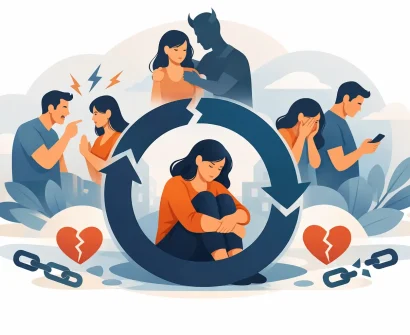



Healing from attachment and trauma begins at the root – montasirmusa.com
[…] testing safety instead of merely thinking about it. This is where the value of trauma-aware approaches becomes apparent, because they don't just analyze the story, but pay attention to what happens […]
لماذا أكرر نفس العلاقات المؤذية؟ – montasirmusa.com
[…] نفهم النمط بطريقة تراعي الصدمة والاستجابات العصبية، يتغير التعامل معه. بدل أن نسأل: […]